
Over nearly 40 years, Bruce Hornsby’s music has gradually moved from telling very specific, personal stories rooted in the American South to exploring much broader, universal ideas. With your help, we’ve broken that journey down into:
- twelve themes
- around 150 songs to fit into those themes, and now:
- five phases of Bruce’s work below
- and whole bunch of numbers!
They’re all listed below and come together in a separate interactive chart: theme trajectories. You can use that to highlight your own patterns or easily see how they develop over time.
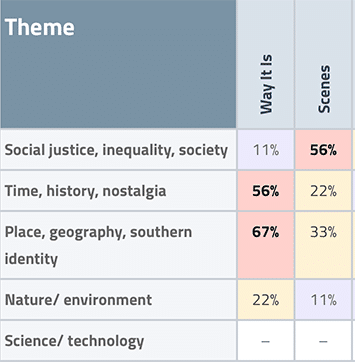
It looks like the one above. It says that based on how you all fit the songs into themes, “Social Justice, inequality and society/social commentary” is covered in 11% of the songs on The Way It Is, and on 56% of the songs on Scenes from the Southside. On the next row down, “Time, history and nostalgia” features in 56% of the tracks on The Way It Is, and 22% of Scenes from the Southside. At the bottom, “Science and technology” doesn’t feature at all in either.
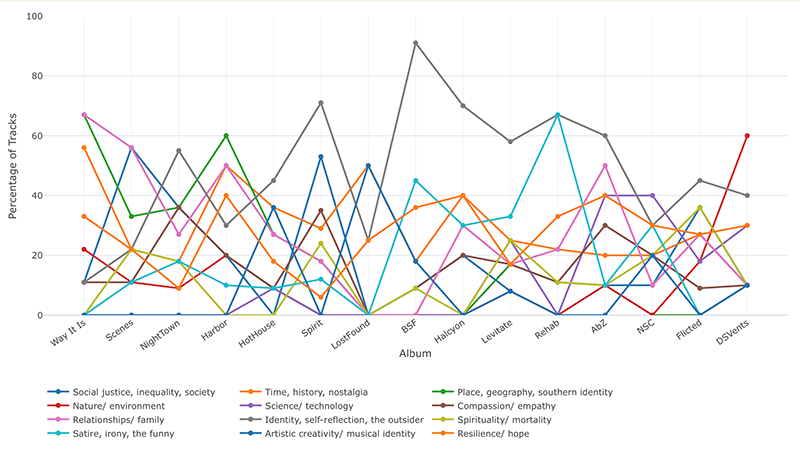
They’re all plotted to map the progress of each theme throughout Bruce’s career – visit the interactive chart to do some of your own digging around and shift the lines around until you’re happy. The main phases and trends that we found are below.
Thematic evolution
People and place (1986–1993):
At the start of his career, Bruce’s songs focused heavily on relationships, memories, and a strong sense of place – especially the South. On The Way It Is, those themes dominate most of the album, with Place and Relationships both at 67% and Time/Nostalgia at 56%. Even when he began touching on social issues in Scenes from the Southside (where Social Justice hits 56%), the music still felt rooted in personal stories and southern identity. That stayed true for years, resurfacing strongly on Harbor Lights with a 60% emphasis on Place.
Turning inward (1995–1998):
In the mid-90s, the focus moved away from the outside world – places and people – and averages higher on inner thoughts and identity. (Identity first became a dominant theme on A Night on the Town in 1990, and never really let go after that, but this period marks a real concentration). This really comes through on Spirit Trail, where Identity reaches 71% and Social Justice 53%, both becoming dominant themes. From this point on, Identity becomes the backbone of Bruce’s work for the next couple of decades.
The satirical pivot (2002–2016):
There’s a sharp break with Big Swing Face. The sense of place disappears completely (it drops to 0%), while Identity jumps to 91% – the highest concentration of any theme in the entire catalogue. At the same time, the music becomes more satirical and humourous. That tone continues through to Rehab Reunion, where Satire and Identity sit side by side at 67% each. During this period, the theme of Science and Technology also starts to appear more regularly, having not seen since Hot House (1995) until Levitate (2009), and growing into a consistent presence.
No single focus (2020):
By the time you get to Non-Secure Connection, the music no longer centres on just one or two big ideas. Instead, it spreads across a wider mix of themes, with no single one dominating. The strongest theme – Science and Technology – levels off at around 40%, making it the only album with no clear dominant focus.
Turning to nature (2024):
On Deep Sea Vents, there’s another clear shift. For the first time, Nature becomes the main focus, reaching 60%. At the same time, Identity drops to its lowest levels since Lost and Found on the Spirit Trail (written around 1998), signalling a move away from inward reflection towards something more environmental and outward-looking.
One constant throughout
Despite all these changes, one thing has always been there: a sense of resilience and perseverance. It appears on every album. Despite this, it never quite becomes the main theme, although it peaks at 40% on Absolute Zero and acts as a steady emotional thread running through the entire catalogue.
Outliers
- Non-Secure Connection (2020) is the only album in the 38-year catalogue where zero themes reach the 45% dominant threshold. The album’s focus is fragmented across ten different themes, with the highest score peaking at only 40% (Science). In contrast, 14 out of 15 albums have at least one theme reaching ≥45%.
- Big Swing Face is known for its departure from Bruce’s previous music. But did you know that the theme of the music changed too? Where those emotional themes of Relationships, Nostalgia and Place/Southern Identity featured really strongly in the first four records, two are entirely absent from Big Swing Face and one (Nostalgia) only reaches 18%. Every other album in the catalogue contains at least one of these themes at a secondary or dominant level.
- Big Swing Face (2002) also features the most concentrated thematic focus in the catalogue. Identity, Self-Reflection & the Outsider reaches 91% (appearing in 10 of 11 tracks). This is 20 percentage points higher than any other theme’s peak in any other album (the next highest being Identity at 71% in Spirit Trail).
- Resilience, Hope & Perseverance is the only theme to achieve 100% catalogue coverage (appearing in all 15 albums). It is never once the dominant theme on an album.
- Nature, Environment & Ecology was a secondary theme or absent from the first 14 albums, and then surged to 60% in Deep Sea Vents. It is the only album in Bruce’s catalogue where Nature is the sole dominant theme.
- Geography, Place & Southern Identity was a founding pillar of the first four albums (1986–1993) averaging 49% (reaching a peak of 67% in The Way It Is). In the subsequent eleven albums from Hot House (1995–2024), it averaged 8.5%, and was completely absent from four records (Big Swing Face, Halcyon Days, Non-Secure Connection, and ’Flicted).
- The Way It Is and Rehab Reunion are the only two albums where two separate themes both reach 67%, although in completely different registers. The Way It Is (Geography and Relationships) and Rehab Reunion (Identity and Satire).
- Non-Secure Connection (2020) features 8 themes at the secondary level simultaneously, the highest variety of secondary themes in any single record.
Although Lost and Found on the Spirit Trail wasn’t released until 2023, the songs were written in 1998 alongside Spirit Trail, so it sits here in the timeline where it belongs – reflecting where Bruce’s head was at creatively, not when the music finally came out.