
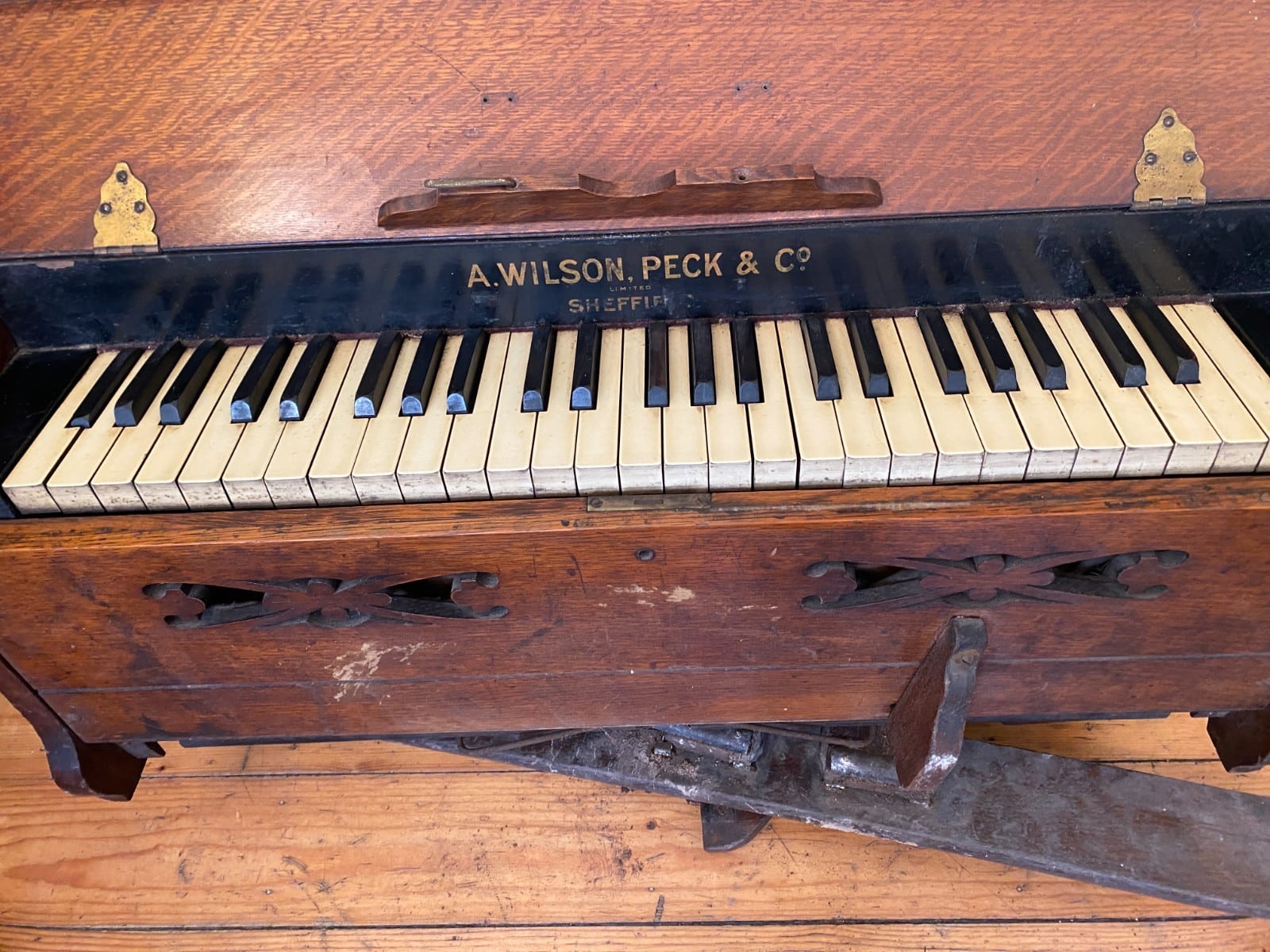
 The harmonium is a keyboard instrument that produces sound using free reeds, similar in principle to the accordion. Air is pushed through metal reeds by bellows, causing them to vibrate and produce tone. The instrument is widely used in South Asian music, devotional settings, and folk traditions, as well as in certain forms of Western music.
Played by:
Bruce Hornsby on:
J.T. Thomas on:
Origins of the harmonium
The harmonium was developed in Europe in the early 19th century, building on earlier free-reed instruments inspired by the Chinese sheng. One of the key figures in its development was Alexandre Debain, who patented a version of the instrument in Paris in 1840. His design used a foot-operated bellows system and a keyboard, allowing for sustained, organ-like sound.
In Europe, the harmonium became popular in churches and homes as a more affordable and compact alternative to the pipe organ. It was especially common in the Victorian era, where it was used for hymn accompaniment and domestic music-making.
Development and global spread
The harmonium spread beyond Europe during the 19th century, particularly through colonial networks. It found a lasting home in India, where it was adapted into a hand-pumped version. Unlike the European model, which used foot pedals, the Indian harmonium is played while seated, with one hand operating bellows at the back and the other playing the keys.
This adaptation made the instrument portable and well suited to Indian musical traditions. It became widely used in Hindustani classical music, devotional music such as bhajans and kirtans, and later in film music. Although initially criticised by some classical purists for its fixed tuning and inability to produce microtones precisely, it eventually became a standard accompanying instrument.
Construction and sound
The harmonium consists of a keyboard connected to a set of reeds housed inside a wooden box. When a key is pressed, air flows over the corresponding reed, producing a note. Stops on the front of the instrument allow the player to control airflow to different sets of reeds, altering the tone and volume.
The sound of the harmonium is steady and sustained, often described as warm and reedy. Because it does not rely on strings or electronic amplification, its tone has a direct, acoustic quality that works well in both solo and ensemble contexts.
Use in different musical traditions
In Western music, the harmonium was commonly used in churches and small venues before being largely replaced by electronic organs. It also appeared in some classical compositions and later in folk and experimental music.
In South Asia, the harmonium became central to many musical forms. It is frequently used to accompany vocalists, providing a drone and melodic support. Its ability to sustain notes makes it particularly effective in devotional and meditative settings.
The instrument has also appeared in modern genres, including folk revival music and certain styles of rock and world music, where its distinctive tone adds a unique texture.
Summary
The harmonium is a significant instrument in both Western and South Asian musical traditions, evolving from a 19th-century European invention into a globally recognised keyboard instrument. Its portability, simplicity, and expressive capability have ensured its enduring use, particularly in vocal accompaniment and devotional music. Despite changes in musical technology, the harmonium remains valued for its warm, sustained sound and cultural importance.