

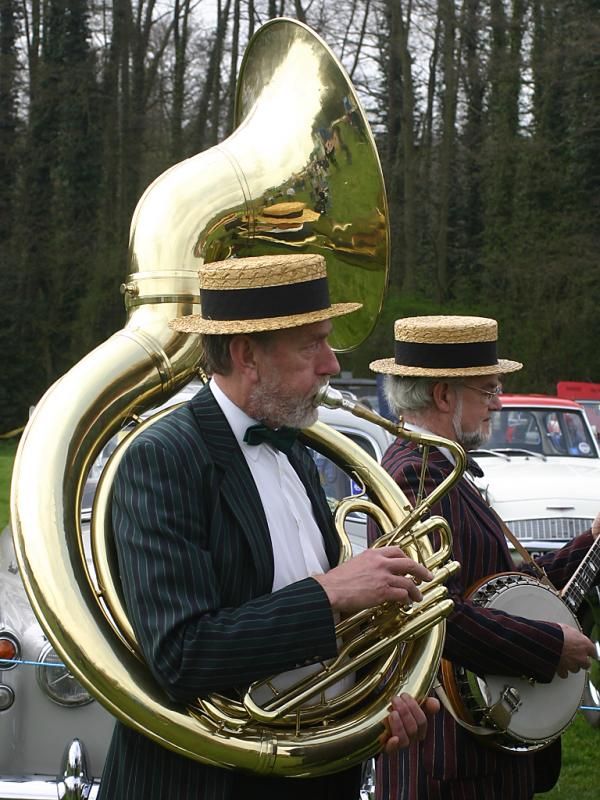
 The sousaphone is a specialised brass instrument created to meet the practical needs of marching performance. Developed in connection with John Philip Sousa, it combines the tonal depth of the tuba with a design suited for movement and projection. Its role in marching bands and New Orleans jazz has made it an enduring and recognisable presence in musical culture.
Played by:
Matt Perrine on:
Sousaphone: an overview
The sousaphone is a large brass instrument designed as a more practical alternative to the tuba for marching and outdoor performance. It is wrapped in a circular shape that fits around the player’s body, with a forward-facing bell that projects sound outward. Known for its deep, powerful tone, the sousaphone provides the bass foundation in marching bands, brass bands, and certain jazz traditions.
Origins of the sousaphone
The sousaphone was developed in the late 19th century and is closely associated with John Philip Sousa, the famous American bandmaster. Sousa wanted a bass instrument that could project sound forward toward audiences during marches, rather than upward like traditional tubas.
Instrument makers, including James Welsh Pepper, created early versions of the sousaphone in the 1890s. These early designs evolved into the modern form, with a large, forward-facing bell and a wrap-around body that allowed the instrument to rest comfortably on the player’s shoulder.
Development and use
The sousaphone was specifically designed for mobility and projection. Unlike the concert tuba, which is typically held upright and used in seated performances, the sousaphone allows musicians to move freely while playing. This made it ideal for marching bands, military bands, and outdoor concerts.
Over time, the instrument’s design was refined for balance, durability, and ease of play. Early sousaphones were made of brass, but later versions included fibreglass models, which are lighter and easier to carry during long performances.
The sousaphone became a standard instrument in American marching bands, particularly in schools and universities, where it remains a defining visual and musical element. Its strong, resonant bass supports the rhythm and harmony of large ensembles.
Role in jazz and popular music
Beyond marching bands, the sousaphone found a place in early jazz, especially in New Orleans. In outdoor settings where string basses were difficult to hear, the sousaphone provided a powerful alternative. It was used to play walking bass lines and rhythmic patterns that helped drive the music.
As jazz moved into indoor venues and recording studios, the double bass gradually replaced the sousaphone in many contexts. However, the instrument remains closely associated with traditional New Orleans jazz and brass band music, where it continues to be used today.
Construction and sound
The sousaphone is typically pitched in B-flat, like many tubas, and uses a system of valves to change pitch. Its long tubing is wrapped into a circular shape, and the large bell, often over 60 centimetres in diameter, faces forward to maximise projection.
Its sound is deep, broad, and powerful, capable of carrying over large outdoor spaces. While primarily used for bass lines, skilled players can achieve a surprising degree of agility and musical expression.